

Most websites fail to rank on Google. The main reason is not weak content. It is the lack of high-quality backlinks.
In 2026, backlinks are still a powerful Google ranking factor. But the approach has changed. Google now rewards relevance, authority, and natural link building patterns. Not bulk or spam links.
Low-quality backlinks can harm your SEO. They can reduce trust and limit your visibility in search results. That is why a safe and strategic approach is important.
In this updated guide, we will show you a clear and practical system. You will learn how to build free, high-quality backlinks step by step. This method follows Google E-E-A-T guidelines and is designed for long-term SEO growth without risk.
Introduction – Why Backlinks Still Matter in 2026
Backlinks are still a strong ranking factor in 2026. They help Google measure trust, authority, and relevance. When other websites link to your content, it signals that your page is valuable and credible.
Backlinks also help:
- Improve how fast Google discovers your pages
- Pass authority (link equity) from one site to another
- Strengthen your website’s topical relevance
Websites with strong backlink profiles consistently outperform competitors in competitive search results.
What are High-Quality Backlinks?
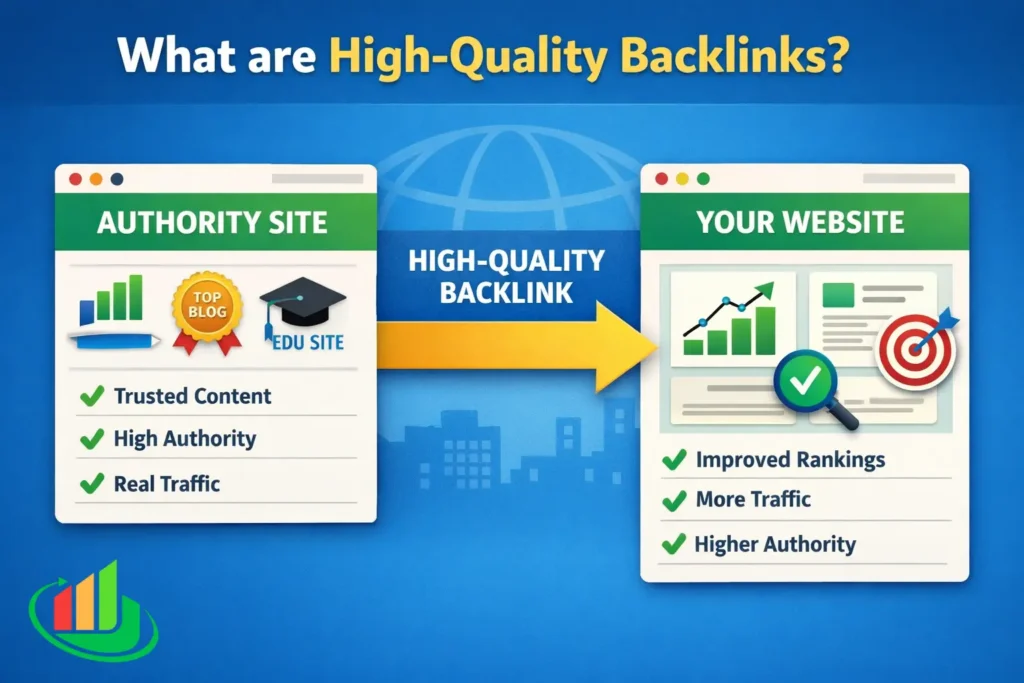
High-quality backlinks are links from trusted, relevant, and authoritative websites. These links show Google that your content is reliable and useful, which improves rankings and organic traffic.
In SEO, relevance and trust are more important than the number of backlinks.
A high-quality backlink usually comes from a website with strong authority, real traffic, and niche relevance. These links are placed naturally inside helpful content, not in spammy or unrelated pages. This keeps your SEO safe and aligned with Google E-E-A-T.
Example:
If a well-known marketing blog like a trusted SEO website publishes an article about digital marketing tips and includes a link to your SEO guide, that is a high-quality backlink. It is relevant, natural, and comes from an authority source, which makes it valuable for ranking.
Why This Backlink Strategy Works in 2026
This system works because it focuses on real SEO signals instead of shortcuts. It builds backlinks from relevant, trusted, and active websites.
Google now prefers natural link patterns, not spam or paid links. This method improves authority, trust, and organic rankings step by step.
It also follows Google E-E-A-T principles, which makes it safe for Core Updates and long-term SEO growth.
The R.A.T.E Backlink Framework
To build high-quality backlinks consistently, follow this simple system:
- R – Relevance: The website should match your niche or topic
- A – Authority: Strong and trusted websites (no fixed DR/DA requirement)
- T – Traffic: The site should have real organic visitors (500+ monthly preferred)
- E – Engagement: The content should have real activity and user interaction
👉 If a backlink meets all four conditions, it is considered high-quality and safe for SEO.
Step-by-Step System to Build Free Quality Backlinks
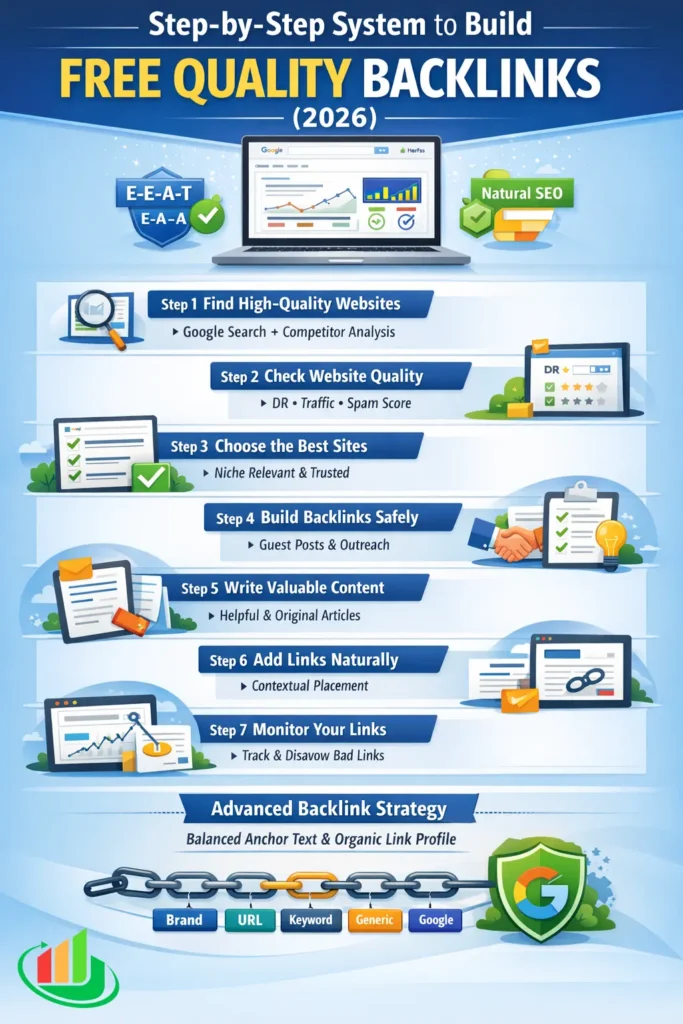
Building free quality backlinks in 2026 requires a clean, structured, and natural SEO approach. The goal is to earn relevant links from trusted websites without spam or shortcuts. This system follows Google E-E-A-T and is safe for Core Updates.
Step 1: Find High-Quality Websites (Where to Get Links)
Start by finding websites in your niche that accept guest posts or content contributions. Use smart search methods to discover real opportunities.
👉 Use Google search operators:
- write for us + niche
- guest post + niche
- inurl: guest-post
- “submit article” + niche
👉 Also:
- Check competitor backlink profiles:
You can also use tools like Ahrefs, SEMrush, or Ubersuggest to analyze competitor backlinks and find new link opportunities. - Find niche blogs manually
- Explore forums and resource pages
Focus only on websites that actively publish high-quality content (at least 1–2 posts per month) and have real audience engagement.
Step 2: Check Website Quality (Filtering System)
Before building any backlink, you should analyze website quality using third-party SEO metrics like Domain Rating (DR), which is not a Google metric but a reference score used by SEO tools.
This ensures your backlink comes from a trusted and relevant source.
👉 Open Ahrefs → Go to Site Explorer → Enter the website URL you want to check.
👉 Check:
- Domain Rating (DR)
- Organic traffic
- Referring domains trend
These factors help you understand whether the website has real SEO value and authority.
✔ Real organic traffic
✔ Strong domain authority
✔ Niche relevance
✔ Low spam score
✔ Properly indexed on Google
👉 You can also verify website quality using tools like Google search (index check), Ahrefs free tools, and Moz Link Explorer. These tools help you analyze traffic, authority, and relevance.
👉 Rule is simple: if a website does not look trustworthy or useful, skip it.
👉 This process helps you quickly decide whether a website is worth getting a backlink from or not.
Step 3: Choose the Right Websites (Final Selection)
Now filter your list and select only the best websites.
Focus on:
- Same niche websites
- Active and updated content
- Real audience engagement
Avoid random or unrelated sites. Relevance is key for SEO value.
Step 4: How to Actually Build Backlinks (Execution)
Now start link building using safe methods.
👉 Effective methods:
- Guest posting
- Outreach emails
- Profile backlinks
- Broken link building
👉 Simple outreach example:
“Hi, I found your article very useful. I have written a detailed guide that can add value to your readers. Let me know if you would like me to contribute.”
Keep it short and professional.
Step 5: How to Write Content That Gets Accepted
Your content must provide real value to get approved.
👉 Follow this structure:
- Simple English
- Value-focused introduction
- Problem explanation
- Clear solution
- Real example
- Strong conclusion
👉 Important rules:
- No keyword stuffing
- No spam links
- Write for humans first
Step 6: How to Add Backlinks Properly (Placement)
Backlinks should always look natural inside content. Avoid forced placement.
👉 Example:
“Backlinks are important for SEO because they help improve website authority and search rankings.”
Use relevant anchor text and place links where they fit naturally within the context.
Step 7: How to Monitor Backlinks (Very Important)
Tracking backlinks helps you understand performance and SEO impact.
👉 Use these tools:
- Google Search Console
- Ahrefs
- SEMrush
👉 Steps:
- Check new backlinks
- Monitor lost links
- Identify toxic or spam links
- Remove or disavow harmful links
Advanced Backlink Strategy (2026)
In 2026, backlink building is not just about getting links, it is about building a natural and balanced link profile that looks organic to Google.
One of the most important factors is anchor text distribution.
If your anchor text is over-optimized, Google may consider it spammy. A natural backlink profile includes a mix of different anchor types.
If you want to go one step further, you can also learn a smart backlink strategy that focuses on building stronger, more natural and ranking-focused SEO links.
Anchor Text Types (Very Important in 2026)
In SEO, different types of anchor text help create a natural backlink profile. Using only one type can look spammy and may reduce rankings.
| Anchor Type | Meaning | Example | Safe Percentage | SEO Insight / Notes |
| Branded | Your brand or website name | Webs Helping | 50–60% | Most natural and safest type. Builds trust and authority signals. |
| Partial Match | Keyword + variation | backlink strategy guide 2026 | 20–30% | Helps diversify profile and makes links look natural. |
| Generic | Common CTA words | click here, read more | 10–20% | Good for SEO relevance without looking spammy. |
| Exact Match | Exact target keyword | backlink strategy | <5% (Very Low) | High risk if overused. Should be used very carefully. |
| Naked URL | Raw link format | https://www.webshelping.com | 5–10% | Helps create natural backlink profile and diversity. |
What Actually Worked for Me (Real Experience)
After testing different backlink strategies, I focused only on guest posting and manual outreach. Here is what actually happened in real execution:
- Guest posts sent: 35
- Accepted: 8
- Success rate: 22%
- Average response time: 4–7 days
- Highest performing strategy: niche-relevant guest posts
- Low performing method: forum profile links
I noticed that websites with real traffic and strong topical relevance gave the best ranking improvements. Random or low-quality sites had no SEO impact.
The biggest learning was that relevance matters more than authority score alone.
This experience confirmed that consistent outreach to relevant websites works better than any automated backlink method.
Mistakes I Made (And What Happened)
After testing different backlink strategies, I also made several mistakes that affected my SEO performance.
Here are the key ones:
- Used exact match anchor text repeatedly → rankings dropped
- Got backlinks from irrelevant websites → no noticeable impact
- Focused on quantity instead of relevance → wasted effort
- Used low-quality guest sites → no authority improvement
One important lesson I learned was that over-optimized anchor text can make backlinks look unnatural to Google.
Another mistake was ignoring website relevance. Even high DR/DA sites did not help when the niche was unrelated.
Comparison of Different Types of Backlinks
| Backlink Type | Quality Level | SEO Value | Risk Level |
| Guest Post Links | High | Strong | Low |
| Forum Links | Medium | Moderate | Low |
| Profile Links | Low-Medium | Low | Low |
| Paid Links | High (short term) | Risky | High ❌ |
| Spam Links | Very Low | None | Very High ❌ |
How to Know If Your Backlink is High Quality
A high-quality backlink is one that improves your website authority and supports safe SEO growth. It must come from a trusted source and look natural within relevant content. Here is a simple checklist to identify it.
✔ Authority site:
The backlink should come from a website with strong domain authority and a good reputation. Trusted sites like industry blogs, news platforms, or educational websites are ideal. Avoid low-quality or spam sites.
✔ Real traffic:
The referring website should have real organic traffic. This shows that users actually visit and engage with the content. Fake or inactive sites do not provide SEO value.
✔ Relevant topic:
The backlink must come from a website related to your niche. Relevance is important for Google E-E-A-T signals and helps improve topical authority.
✔ Natural placement:
The link should be placed naturally inside useful content. It should not look forced or spammy. A natural context makes the backlink safe for Google Core Updates and long-term ranking.
Common Mistakes Beginners Make
Building backlinks the wrong way can harm your SEO and reduce your Google rankings. Many beginners focus on shortcuts instead of safe and natural link building. Avoid these common mistakes to stay aligned with Google E-E-A-T and Core Updates.
- Spam backlinks
Creating too many low-quality or automated backlinks from spam sites. These links have no SEO value and can lead to penalties.
- Irrelevant websites
Getting backlinks from websites that are not related to your niche. This reduces relevance and weakens your topical authority.
- Over-optimized anchor text
Using the same keyword-rich anchor text again and again. This looks unnatural and can trigger Google penalties.
- Buying links
Purchasing backlinks from link farms or private networks. This violates Google guidelines and risks long-term ranking loss.
People Also Ask (FAQ Section)
Q1: Are backlinks still important?
Yes. Backlinks are still a key Google ranking factor.
Q2: Do backlinks from forums still work?
Yes. They work only when they are relevant and provide real value.
Q3: Are nofollow backlinks useful?
Yes. They help build a natural and balanced link profile.
Q4: Can bad backlinks hurt SEO?
Yes. Spam links can reduce trust and harm rankings.
Q5: Is buying backlinks safe?
No. Paid links can lead to Google penalties.
Q6: How do I find free backlinks?
Use guest posting, niche blogs, forums, and competitor backlink analysis.
Q7: How many backlinks are enough?
There is no fixed number. Focus on quality backlinks from relevant sites.
Q8: What makes a backlink high quality?
A link from an authority site with real traffic and relevant content is high quality.
Q9: How long does it take to see results?
It can take a few weeks to months depending on link quality and consistency.
Real Example
Here is a real example of how backlink building improves SEO performance.
When I started my website, I already had content, but there were no backlinks. My pages were not ranking on Google, and organic traffic was almost zero. My site had very low authority.
Then I followed a proper backlink strategy. I focused on guest posting, forum engagement, and creating valuable content. Slowly, I also started getting natural backlinks from relevant websites.
Within a few weeks, I noticed clear improvement. My rankings increased, keywords started moving up on Google, and organic traffic grew steadily. Now my website has stronger trust and better authority.
CASE STUDY
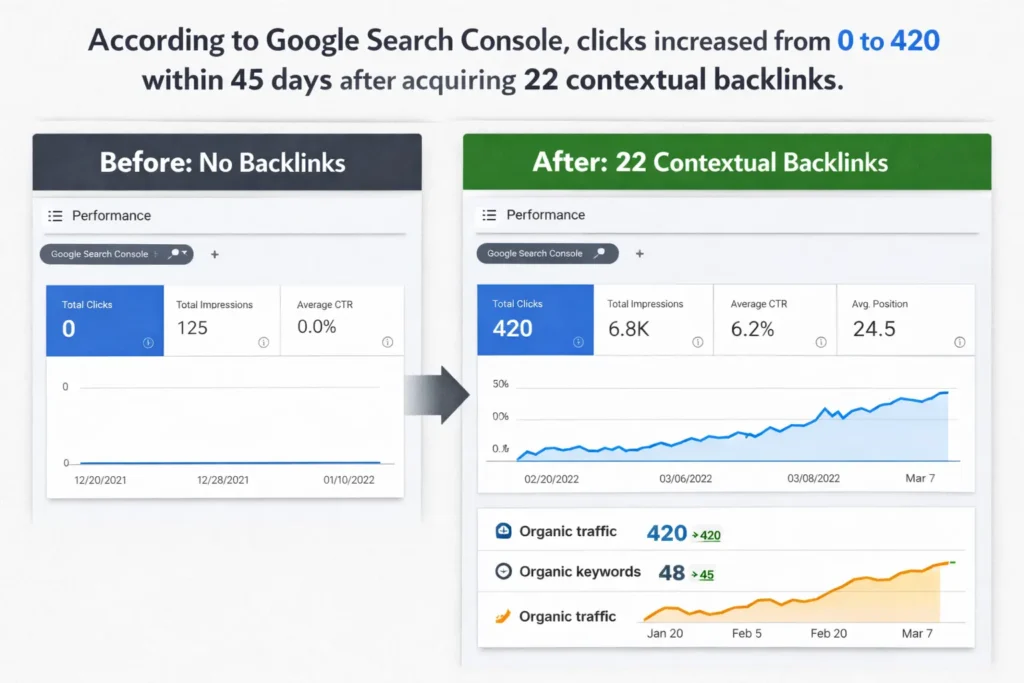
“According to Google Search Console data, clicks increased from 0 to approximately 420 within 45 days after acquiring 22 contextual backlinks.”
Organic traffic grew from 0 to 420 monthly visitors.
Website authority also improved due to 22 high-quality backlinks from niche-relevant websites.
More than 45 keywords started appearing in Google search results.
Timeline breakdown:
- Week 1–2: Website audit was completed and backlink planning started
- Week 3–4: Guest posting and outreach campaigns were launched
- Week 5–6: First ranking improvements and traffic growth were noticed
This growth was achieved using only white-hat SEO methods.
No paid links or spam techniques were used.
These results show that consistent, high-quality backlink building can improve Google rankings, increase organic traffic, and strengthen domain trust over time.
Conclusion: How to Get Free High-Quality Backlinks in 2026?
This backlink strategy is based on modern Google ranking signals and real-world SEO performance patterns. It focuses on relevance, authority, and natural link building. No shortcuts or automation are used.
This approach is safe for Google Core Updates and supports long-term SEO growth.
When applied consistently, it helps build a strong and trusted backlink profile. This improves search visibility, rankings, and organic traffic in competitive search results.
Get Professional Backlink Services
Building high-quality backlinks takes time, effort, and the right strategy. If you want faster and more reliable results, you can work with a trusted SEO team.
At Webs Helping, we provide safe and effective backlink services, including guest posting and niche-relevant link building.
Our approach focuses on:
- High-quality, relevant websites
- Natural link placement
- Long-term SEO growth
If you are looking for a trusted platform to build backlinks without risk, you can explore our services and see how we can help improve your rankings.
About the Author
Hi, we are Webs Helping, a team focused on SEO and backlink strategies for blogs and business websites.
We actively work on search engine optimization, content SEO, and backlink building strategies based on real testing and project experience.
This article is based on practical SEO methods we have tested across different websites to understand what actually works in Google rankings.
Our goal is to share clean, safe, and effective SEO strategies that help websites grow without spam or shortcuts.