
Backlinks have always been the backbone of SEO, but in 2025 they work in new ways.
To create smart backlinks in 2025, focus on building links from relevant, high-authority websites that match your niche and provide real value to users. Search engines now reward backlinks that prove trust, expertise, and content quality, while low-quality links can lower your visibility.
Why Backlinks in 2025 are Different? (Evolution & Google Updates)
Backlinks continue to be a key ranking factor, but in 2025 their role has evolved. Google now focuses on quality, trust, relevance, and user value rather than sheer numbers. Backlinks from trusted, niche-specific websites that add real value can improve your SEO, while low-quality or irrelevant links may hurt your rankings.
Impact of Google Updates:
Google’s algorithm updates prioritize user experience, E-E-A-T, and content relevance. Links from trusted, relevant websites boost your SEO, but low-quality or irrelevant links can hurt your rankings.
What are Smart Backlinks?
Smart backlinks are meaningful connections from trusted and relevant websites that add real value to your content. Unlike random or bulk links, they focus on authority, niche relevance, and user experience, making them powerful for SEO growth in 2025.
Types of Backlinks for SEO Success:
- Natural Backlinks: Earned when other websites link to your content because it’s valuable and trustworthy, without you asking.
- Manual Backlinks: Built through planned efforts like guest posting, influencer outreach, or partnerships.
- Self-Created Backlinks: Links you place yourself in forums, directories, or comments; useful only when relevant and high-quality.
- High-Quality Backlinks: Links from authority, niche-relevant, and trusted sites that boost rankings.
- Low-Quality Backlinks: Spammy, irrelevant, or paid links that can harm SEO performance.
Real Backlink Results and Experience
When I started working on backlinks, I tried many random methods but most of them didn’t work.
Later, I focused on a few simple things:
- Getting links from related websites
- Writing guest posts
- Avoiding spammy backlinks
After building around 40+ good backlinks, I started seeing my pages move up in Google.
So from my experience, quality matters more than quantity.
High-quality backlinks vs Low-quality backlinks:
Factor | High-Quality Backlinks | Low-Quality Backlinks |
| Source | From authority, niche-relevant sites | From spammy, irrelevant, or unknown sites |
| Trust & Authority | Improve domain authority and trust | Lower trust, risk of penalties |
| Relevance | Closely related to your industry or topic | Unrelated to your niche or audience |
| User Value | Directs real, engaged traffic | Brings little to no useful traffic |
| Google’s View | Seen as a positive ranking signal | Can trigger ranking drops or manual actions |
| Long-Term Impact | Supports stable, sustainable SEO growth | Short-term, harmful, and unsustainable |
Simple Case Study
I tested this strategy on a new page targeting a low competition keyword.
At the start, the page was not ranking.
Then I built some backlinks step by step:
- A few guest posts
- Some niche edits
- And some profile links
After some time, the page started ranking and slowly moved to page 1.
This showed me that smart backlinks can really work if you do them the right way.
How to Identify High-Quality Websites for Backlinking in 2025?
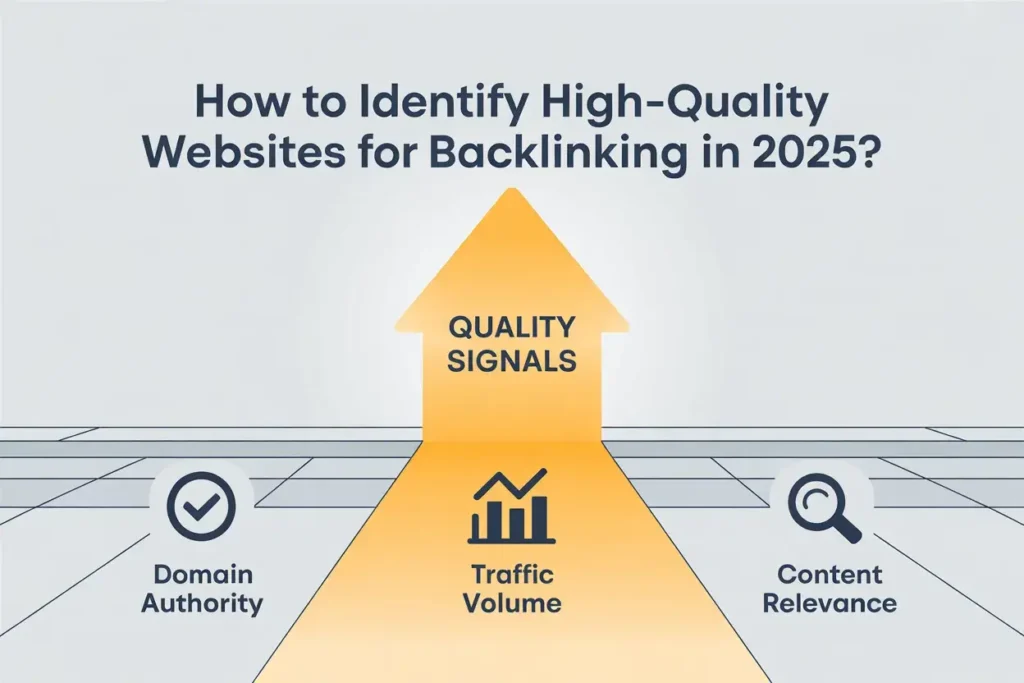
- Check Domain Authority (DA/DR) and Trust Flow:
Use tools like Ahrefs, Moz, or Majestic to see if the website has strong authority and a history of reliable backlinks.
- Check Website Relevance and Niche:
Make sure the site covers topics related to your business or industry. A niche-relevant link has more SEO value than a random one.
- Evaluate Content Quality:
Look for well-written, updated, and valuable content. High-quality sites only link to strong resources.
- Review Traffic Metrics:
Use SimilarWeb or SEMrush to see if the site has steady, real traffic, not just inflated numbers.
- Look at Outbound Links:
A good site links only to trustworthy, relevant resources, not spam or link farms.
- Check Indexing and Spam Score:
Ensure the site is indexed by Google and has a low spam score to avoid harmful backlinks.
Smart Ways to Create Backlinks in 2025 to Attract Maximum Traffic:
Step 1: Identify Niche-Relevant Websites:
Find trusted websites and blogs in your niche; links from relevant sources are more valuable.
Step 2: Create Value-Driven Content:
Publish original, helpful content like guides, case studies, and resources that others naturally want to link to.
Step 3: Personalize Your Outreach:
Contact site owners or bloggers with tailored messages showing why your content adds value to their audience.
Step 4: Leverage Guest Posting & Partnerships:
Collaborate with blogs, influencers, or businesses for guest posts and content partnerships to earn backlinks.
Step 5: Use Visual & Interactive Assets:
Create infographics, videos, or interactive tools that are shareable and attract natural links.
Step 6: Monitor and Maintain Links:
Track backlinks regularly and request replacements for broken or lost links to maintain a healthy profile.
Best Practices for Building Smart Backlinks:
- Target authority sites: Backlinks from well-known and credible websites boost trust and rankings.
- Diversify anchor text: Use natural wording for links instead of repeating the same keyword.
- Build relationships: Connect with bloggers, influencers, and site owners to earn authentic links.
- Stay white-hat: Avoid paid or spammy link schemes that can lead to Google penalties.
Proven Link Building Techniques to Use in 2025:
Building backlinks in 2025 is about using tested methods that bring real results without risking penalties. Some of the most effective techniques include:
- Guest Posting and Partnerships: Write valuable content for trusted websites in your niche to gain quality backlinks and brand exposure.
- Influencer Outreach: Connect with industry experts and collaborate on content, reviews, or interviews that naturally include your links.
- Broken Link Building: Search for web pages with outdated or dead links, then recommend your page as a useful replacement.
- Resource Pages: Get listed on resource or tools pages relevant to your industry where people search for trusted recommendations.
- Competitor Backlink Analysis: Study where your competitors are getting links and target similar opportunities.
These strategies are reliable, safe, and align with Google’s guidelines for sustainable SEO growth.
Competitor Analysis for Smarter Backlink Opportunities:
Competitor analysis helps you discover backlink sources that are already working for others in your niche. Instead of guessing where to build links, you can study your competitors’ strategies and find proven opportunities. Here’s how you can do it:
- Step 1: Identify top competitors:
List the websites that rank higher than you for your main keywords. These are your direct SEO competitors.
- Step 2: Analyze their backlink sources:
Use tools like Ahrefs or SEMrush to check which websites are linking to them. Pay attention to high-authority and niche-relevant domains.
- Step 3: Find gaps and opportunities:
Look for backlink sources your competitors have but you don’t. Reach out to those sites with better content, guest posts, or updated resources to secure your own backlinks.
By following this process, you can target backlinks that already bring results in your industry, saving time and building links more strategically.
The Role of Content in Backlink Strategy (E-E-A-T Focused):
- Show Experience: Share real-life examples, case studies, or results from your work so readers trust your content.
- Show Expertise: Provide well-researched insights, guides, and data that prove you are a specialist in your niche.
- Build Authoritativeness: Publish content on trusted platforms, get mentioned by industry leaders, and showcase credentials.
- Maintain Trustworthiness: Use reliable sources, fact-check your content, and ensure accuracy to build reader confidence.
- Create Link-Worthy Content: Produce valuable blogs, visuals, or tools that naturally attract backlinks from other sites.
How to Monitor and Analyze Your Backlink Profile Effectively?
- Use SEO tools like Ahrefs, SEMrush, or Google Search Console to track new and lost backlinks.
- Check link quality by reviewing authority, relevance, and anchor text.
- Identify harmful links and disavow them to avoid penalties.
How to disavow harmful links? (step by step)
- Find toxic links:
Use Google Search Console, Ahrefs, or SEMrush to export your backlink list. Flag spammy, irrelevant, or exact-match anchor links.
- Confirm they are harmful:
Check relevance, domain quality, language, and anchor text. Remove only links that look unnatural or risky.
- Request removal first:
Email the site owner and ask for removal or a nofollow tag. Save proof of outreach.
- Make a disavow file (.txt):
Put one item per line. Use domain: for whole domains or the full URL for single pages. Comments can start with #.
# Example
For all links in one domain: domain:example.com
For Single page in a domain: https://example.com/your-spam-page-url
- Upload in Google Search Console:
Open the Disavow Links tool, choose the correct property, upload the .txt file, and submit.
- Monitor results:
Recheck links in GSC and your SEO tool. Update the file if needed and focus on earning high-quality, relevant backlinks.
Disavow is an advanced fix. Use it when you have a manual action or a large volume of clear spam, not for normal links.
Best SEO Tools in 2025 for Backlink Monitoring and Analysis:
| Tool | Best For | Key Strengths |
| Ahrefs | SEO professionals, strategists | Huge backlink index, competitor analysis, broken link checks, content insights |
| SEMrush | Agencies, enterprise SEO teams | Real-time backlink tracking, toxic link detection, backlink gap analysis |
| Moz Pro | Small businesses, consultants | Easy interface, Spam Score, link tracking, domain authority metrics |
| Majestic | Technical SEOs, link analysts | Trust Flow, Citation Flow metrics, deep link context, historic data |
| SE Ranking | Budget marketers, freelancers | Affordable, real-time backlink dashboard, white-label reports |
| Monitor Backlinks | Small teams, bloggers | Backlink notifications, keyword rank impact, SEO dashboard |
| BacklinkManager | Agencies with multiple clients | CRM-style backlink tracking, collaboration features, reporting |
| Google Search Console | Every website owner | Free tool, direct backlink data, disavow support |
- Ahrefs and SEMrush are best for deep insights and competitor research.
- Moz Pro and Majestic focus on usability and detailed link metrics.
- SE Ranking and Linkody are affordable choices for freelancers or small teams.
- BacklinkManager helps agencies manage multiple projects.
- SEO SpyGlass is useful for desktop-based audits without subscriptions.
- Google Search Console is free and reliable for basic backlink checks.
How to Choose the Right Tool?
Not every SEO tool fits all businesses. To find the best one, follow these steps:
- Set your goal: Decide if you want detailed backlink tracking, full SEO analysis, or simple performance reports.
- Check features: Compare what each tool offers (link audits, competitor analysis, reporting).
- Look at ease of use: Choose a tool with a dashboard you can understand quickly.
- Match with budget: Pick the one that gives value without overspending.
- Test with trial: Many tools offer free trials, so test before committing.
The right tool is the one that aligns with your SEO goals, budget, and comfort level.
Common Mistakes to Avoid in Backlink Building:
- Overusing exact-match anchor text: Using the same keyword repeatedly looks unnatural and may trigger penalties.
- Buying links or using black-hat tactics: Paid or manipulative links may cause Google penalties.
- Neglecting link monitoring: Failing to track lost or broken links can reduce SEO effectiveness.
- Focusing only on quantity: A few high-quality backlinks are much better and valuable than dozens of low-value links.
Why are SEO link-building services important?
Many businesses find it hard to build high-quality backlinks consistently. Creating effective backlinks takes time, expertise, and the right tools like Ahrefs, SEMrush, and outreach systems.
Professional SEO agencies ensure backlinks are:
- From relevant, authority websites
- Built using safe, white-hat techniques
- Designed to improve long-term SEO performance
Hiring an agency saves time and ensures your website stays safe from SEO penalties, while helping you earn links that truly boost search rankings.
Who is a Trusted Link-Building Agency?
Webs Helping is a trusted choice for building high-quality backlinks safely. Using white-hat strategies and focusing on relevant authority websites, we help businesses improve long-term SEO rankings.
Learn more about our backlink services to strengthen your online presence.
The Future of Backlinks in SEO: Predictions for 2025 and Beyond:
Predictions for 2025 and Beyond:
Backlinks continue to play a key role in SEO, but the focus will shift even more toward quality, relevance, and trust. Search engines will reward links that reflect genuine authority, engagement, and user value rather than quantity.
AI and Automation in Link Building:
Artificial intelligence and automation tools will help identify high-quality backlink opportunities, streamline outreach, and monitor links efficiently. However, human oversight will remain crucial to maintain relevance, authenticity, and compliance with Google’s guidelines.
FAQs:
How many backlinks are enough for strong SEO in 2025?
There is no fixed number. Focus on high-quality, relevant backlinks from authority sites rather than chasing quantity. A few strong links are more effective than many low-value ones.
Are backlinks still important in 2025?
Yes, backlinks remain a key ranking factor. Search engines prioritize links that show trust, authority, and relevance.
What’s the best strategy for building backlinks?
Create valuable, link-worthy content, target niche-relevant websites, use guest posting and outreach, and maintain high-quality, natural link profiles.
Can backlinks hurt my SEO ranking?
Yes, spammy, irrelevant, or low-quality links can lower rankings. Always focus on white-hat techniques to monitor your backlink profile regularly.
What are the best backlink tools in 2025?
| Tool | Short Description & Benefit |
| Ahrefs | Comprehensive backlink index and competitor analysis. Great for discovering lost or broken links and tracking link growth. |
| SEMrush | Real-time backlink monitoring, toxic link detection, and gap analysis. Ideal for agencies and enterprise SEO teams. |
| Moz Pro | User-friendly platform with domain authority metrics, spam score, and link tracking. Perfect for small businesses and consultants. |
| Majestic | Provides Trust Flow & Citation Flow metrics and historical backlink data. Useful for technical SEOs and link analysts. |
| SE Ranking | Affordable, real-time backlink dashboard with white-label reporting. Best for freelancers and small teams. |
| Google Search Console | Free tool for checking backlinks, indexing status, and submitting disavow files. Essential for every website owner. |
Each tool helps track backlinks, evaluate link quality, analyze competitors, and improve overall SEO performance.
Conclusion Create Smart Backlinks:
- Build backlinks only from relevant and authority websites.
- Focus on quality over quantity for long-term SEO benefits.
- Monitor your backlink profile monthly to track new, lost, or harmful links.
- Disavow toxic links immediately to protect your website from penalties.
About Me
Hi, I run WebsHelping. I work on SEO and backlinks for my own projects and client websites.
I like to test things myself instead of just copying what others say. This article is based on what I have actually tried and what worked for me.